 Envio gratuito: Encomendas da Irlanda superiores a €50 | Reino Unido e Europa superiores a €100.

VO2 max is one of the most talked-about numbers in endurance sport. Watches estimate it, athletes compare it, and training apps often treat it as a badge of fitness.
Used well, VO2 max testing can be genuinely useful. It gives runners, cyclists and triathletes a measured view of maximal oxygen uptake and can support better conversations about training zones, current fitness, and where an athlete might be limited. Used badly, it becomes just another score to chase without changing the training.
This guide explains what a VO2 max test tells you, what it does not tell you, and when booking a lab-based test at Endurance Lab is worth considering.
The Short Answer
VO2 max testing is most useful when you want objective data about your aerobic ceiling, when your watch estimates seem unreliable, when you are setting training zones for a new block, or when you want a baseline before retesting later.
It is less useful if you only want a single number to compare with friends. A strong VO2 max does not automatically mean you will race well. Endurance performance also depends on threshold, economy, durability, fuelling, pacing, heat tolerance, recovery, and the specific demands of your sport.
What VO2 Max Actually Measures
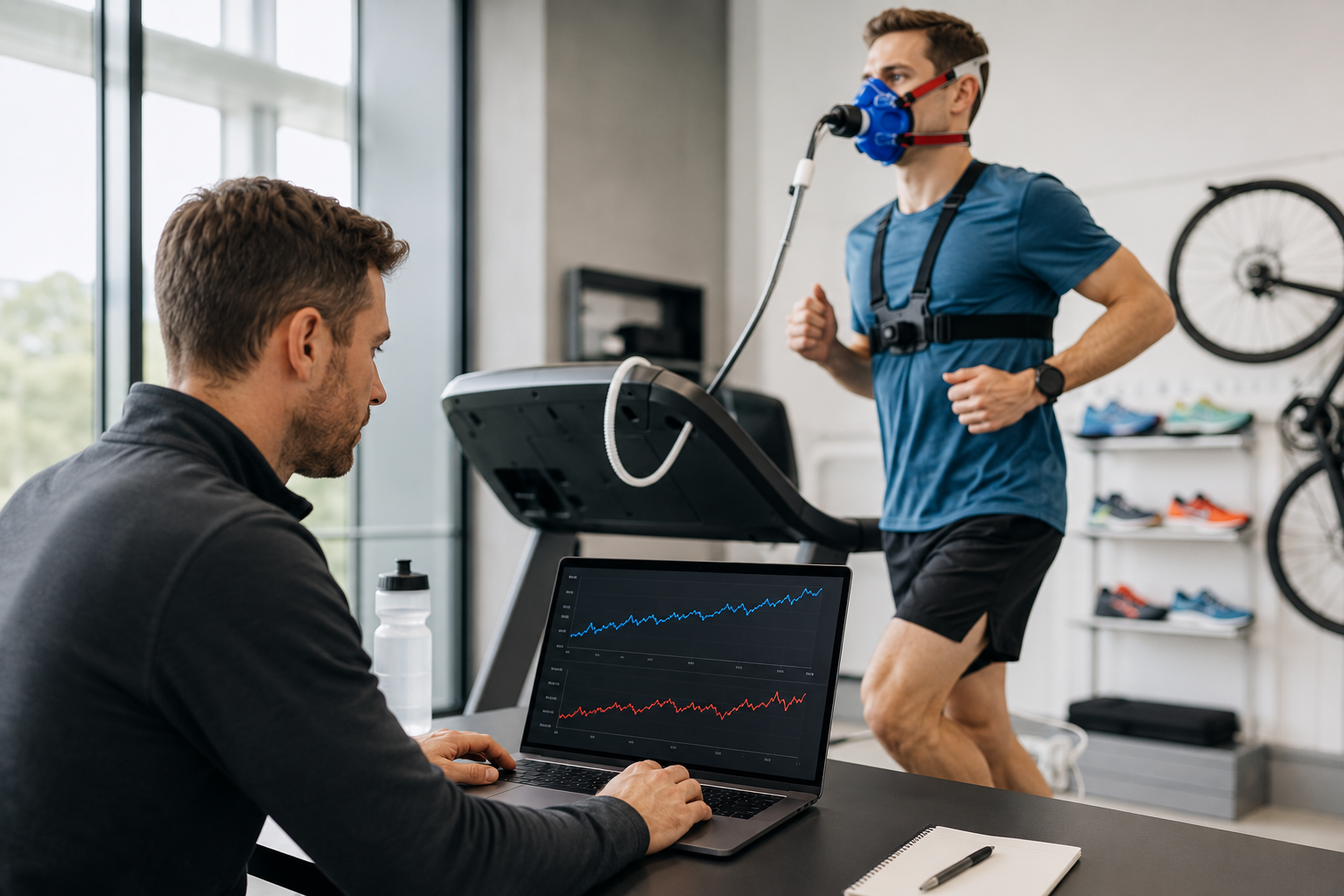
VO2 max is the maximum rate at which your body can take in, transport, and use oxygen during hard exercise. In a lab setting, it is commonly measured during a graded exercise test while breathing through a mask connected to metabolic analysis equipment.
The result is often reported relative to body mass in millilitres of oxygen per kilogram per minute. That makes it easier to compare between athletes of different sizes, but it is still only one part of the performance picture.
For endurance athletes, the useful question is not simply, "Is my VO2 max high?" A better question is, "What does this result tell me about the training I should do next?"
What a VO2 Max Test Can Tell You
Your current aerobic ceiling
A measured test gives a more direct view of maximal aerobic capacity than a watch estimate or a race-time prediction. That can be helpful if you want a clean baseline before a training block, a return from injury, or a shift from general training into race-specific preparation.
Whether your wearable estimate is worth trusting
Modern watches can be useful, but they are still estimating from pace, heart rate, power, terrain, and algorithms. A 2025 systematic review on wearable estimates of VO2 max and lactate threshold found that wearable-derived values can be useful in some contexts, but accuracy varies by device, population, and training status. For highly trained athletes, lab testing remains the cleaner reference point.
How your result fits your sport
VO2 max is exercise-mode specific. A review in Sports Medicine noted that runners often achieve higher VO2 max values on a treadmill, while cyclists may test closer to their sport-specific capacity on a bike ergometer. Triathletes may need to think carefully about which mode best answers the current training question.
A baseline for retesting
One test is a snapshot. Two well-controlled tests, separated by a meaningful training block, can show whether your aerobic capacity has changed. The key is keeping the test conditions as similar as possible: same mode, similar fatigue level, similar timing, and similar preparation.
What VO2 Max Does Not Tell You
It does not guarantee race performance
Two athletes can have similar VO2 max results and very different marathon, 70.3, or cycling time-trial outcomes. Threshold, movement economy, pacing skill, nutrition, heat management, and consistency all matter.
It does not replace lactate or threshold testing
VO2 max helps describe your ceiling. Threshold testing helps describe how much of that ceiling you can use sustainably. For many endurance races, the second question is often more directly tied to pacing and training-zone decisions.
It does not diagnose health problems
Endurance Lab's VO2 Max Testing service is for performance and training insight. It is not a medical diagnostic test. If you have chest pain, unexplained breathlessness, fainting, known cardiovascular disease, or any medical concern, speak with a qualified medical professional before high-intensity testing.
Who Should Consider Booking a VO2 Max Test?
A VO2 max test can be a good fit if you are:
- Starting a structured endurance training block and want a measured baseline.
- Training for running, cycling, triathlon, or another endurance event where aerobic capacity matters.
- Unsure whether your watch VO2 max estimate reflects reality.
- Returning from a break and want objective data before rebuilding intensity.
- Working with a coach who can translate test results into training decisions.
- Planning to retest after a clear training block rather than testing randomly.
It may not be necessary if you are new to endurance sport and still building basic consistency. In that case, regular training, good fuelling, sleep, and simple progression usually come before advanced testing.
How to Prepare for a Useful Test
A VO2 max test is hard by design, so preparation matters. You do not need to taper like race week, but you should arrive in a state that reflects normal fitness rather than accumulated fatigue.
- Avoid very hard training in the 24-48 hours before the test.
- Eat normally and avoid experimenting with new foods or supplements.
- Bring the shoes, cycling kit, or training gear you would normally use for the chosen test mode.
- Tell the tester about recent illness, injury, medication, or unusual fatigue.
- Do not book the test if you feel unwell or have medical symptoms that need professional review.
How to Use Your Results Afterward
The most useful output is not the number by itself. It is what the number helps you decide.
If your VO2 max is solid but your race pace fades late, the answer may be durability, fuelling, pacing, or threshold work rather than more maximal intervals. If your aerobic ceiling is lower than expected, a coach may choose a training block that develops aerobic capacity more deliberately. If your test result is close to your wearable estimate, you may have more confidence using the watch trend over time.
You can also combine VO2 max testing with other performance inputs. Endurance Lab's Performance Lab collection is where testing services sit alongside the broader support ecosystem. Athletes who prefer their own field-testing tools can browse testing equipment, while cyclists making training decisions from power can also read our guide to single-sided versus dual-sided power meter pedals.
Why Testing Mode Matters for Runners, Cyclists and Triathletes
A runner testing on a treadmill and a cyclist testing on a bike are not answering exactly the same question. The muscles used, movement economy, posture, and technical demands differ. That is why a sport-specific test mode is usually more useful than chasing the highest possible score in a mode you do not race.
For triathletes, the best choice depends on the question. If bike pacing is the main issue, bike-based data may be more useful. If run durability or running economy is the issue, treadmill data may be more relevant. The test should serve the training decision, not the other way around.
When to Retest
Retesting too often creates noise. A practical approach is to test before and after a meaningful block, often 8-16 weeks depending on the athlete and goal. Retest sooner only if there is a clear reason: return from injury, major training change, or a coach-led decision point.
Keep the conditions similar. Same mode, similar time of day, similar freshness, and similar fuelling. Otherwise, you may be comparing test-day circumstances rather than fitness.
FAQ
Is VO2 max the most important number for endurance athletes?
No. It is important, but it is not the whole performance model. Threshold, economy, durability, pacing, fuelling, recovery and sport-specific skill all matter.
Is lab VO2 max testing better than a watch estimate?
A lab test is a more direct measurement. A watch estimate can still be useful for tracking trends, but it should be treated as an estimate, especially for athletes whose training, terrain, heat exposure, or heart-rate data quality varies.
Should I test on a treadmill or bike?
Choose the mode that best matches the question. Runners often get more relevant data from treadmill testing, cyclists from bike testing, and triathletes should choose based on the discipline they most need to understand.
Can VO2 max testing set my training zones?
It can support zone-setting, especially when interpreted by a qualified professional or coach, but threshold and field data may still be needed. Do not build an entire training plan from one number alone.
Book VO2 Max Testing at Endurance Lab
If you want a measured baseline rather than another estimate, VO2 Max Testing at Endurance Lab is a one-hour service for runners, cyclists, triathletes and performance-focused athletes. The appointment is priced at €150 and should be used as a training-insight tool, not as a medical diagnostic test.
Book it when the result will change a decision: setting up a training block, reviewing a plateau, validating wearable estimates, or creating a baseline before a structured retest.
Research Notes
- ACSM's Guidelines for Exercise Testing and Prescription - professional reference for exercise testing and prescription standards.
- ACSM: The Importance of Cardiorespiratory Fitness, A 10-Year Update - overview of cardiorespiratory fitness as an important health and performance marker.
- Millet, Vleck and Bentley, Sports Medicine 2009 - review of physiological differences between cycling and running, including sport-specific VO2 max considerations.
- Midgley et al., practical considerations in VO2 max testing in runners - classic discussion of validity and reliability issues in runner testing.
- Frontiers in Sports and Active Living 2025 systematic review - review of wearable accuracy for VO2 max and lactate-threshold estimates.